
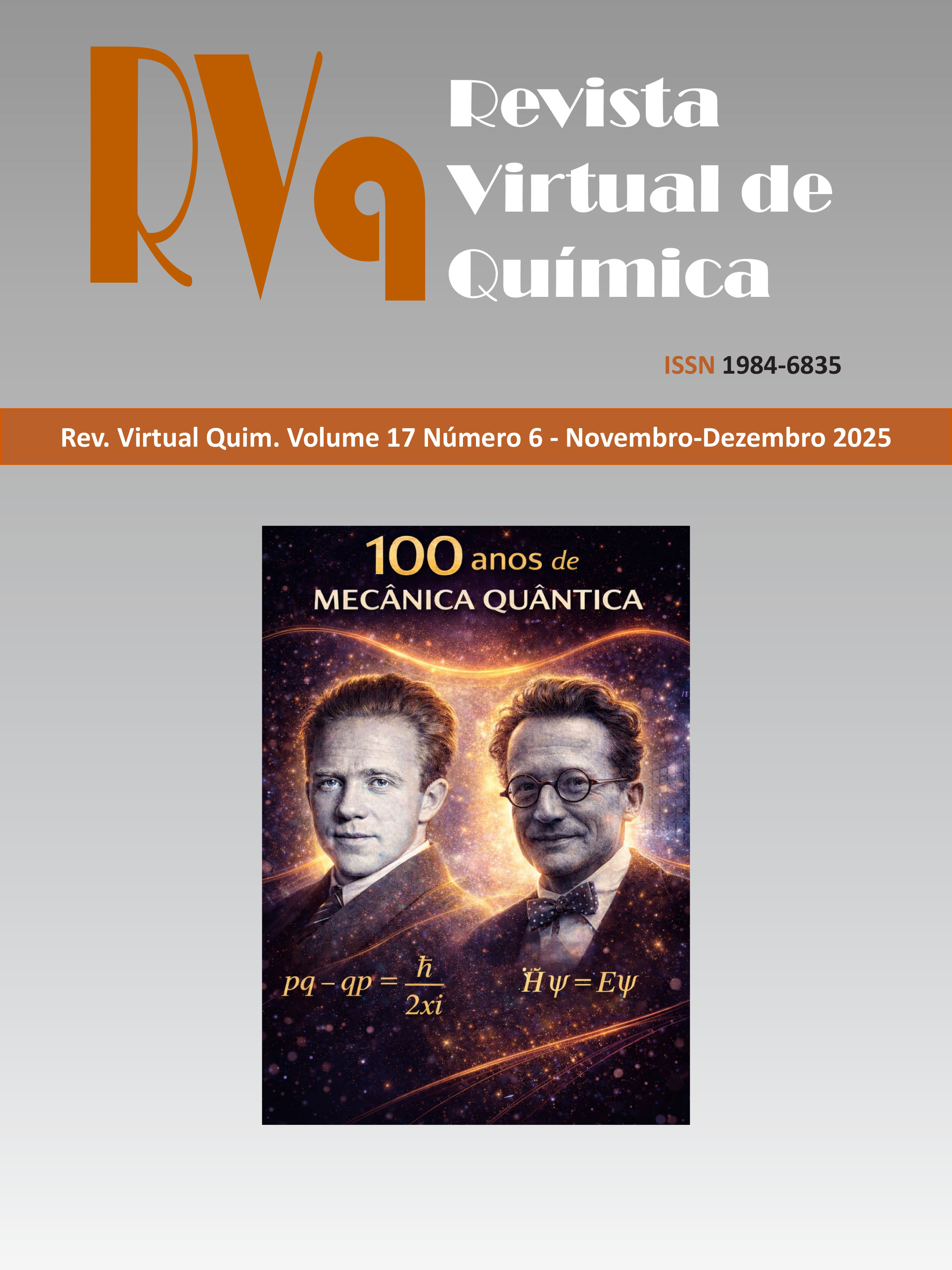
100 Anos da “Nova” Mecânica Quântica de Heisenberg
DOI:
https://doi.org/10.21577/1984-6835.20250058Resumo
Heisenberg’s quantum mechanics, generalized by Born and Jordan, highlighted the need for a kinematic
reformulation of the concepts of position and momentum of an atomic system, which should be represented
by matrices instead of vectors in a three-dimensional Euclidean space. Although these new dynamical
variables must satisfy equations of motion formally similar to the classical equations, they are not the
objects to be directly observed in the laboratory. Contrary to common sense, these matrices provide the
correct way of representing the dynamical processes of absorption and emission of electromagnetic
radiation at the atomic scale in terms of quantities observed in the laboratory, such as frequencies and
intensities of the electronic transitions occurring in the system. One hundred years on, the construction of
the Heisenberg’s “new” mechanics has generated a race to develop the operational aspects of the theory,
as well as its general interpretation. Needless to say, both the interest in and the controversy over the
interpretation of quantum mechanics as we know it today remain quite intense, more than a century after
the development of the concept of quantization of the emitted/absorbed light by an atomic oscillator.
Long live the most accurate theory currently used to describe the structure of matter.
Keywords: Electronic transition; Fourier transform; Rydberg-Ritz principle; observables.
Downloads
Publicado
Edição
Seção
Licença
Copyright (c) 2025 Revista Virtual de Química

Este trabalho está licenciado sob uma licença Creative Commons Attribution 4.0 International License.
Autores que publicam nesta revista concordam com os seguintes termos:
Os direitos autorais para artigos publicados nesta revista são do autor, com direitos de primeira publicação para a revista. Em virtude do acesso público, os artigos são de uso gratuito em aplicações educacionais e não-comerciais desde que com reconhecimento da autoria e da publicação nesta revista.